Get Cheshire Eating Well Strategy 2026-2031
Why is it important to eat well?
A healthy diet is a foundation for good health throughout life, yet national dietary surveys consistently show that most people in the UK do not meet the recommended nutritional guidelines.
The Eatwell Guide sets out what a balanced diet should look like, but the National Diet and Nutrition Survey highlights persistent gaps, including low consumption of fruit, vegetables and fibre and higher intakes of sugar, saturated fat and salt than recommended. These patterns vary across the different life stages and are strongly shaped by wider social conditions meaning that dietary opportunities are not equal for all. As a result, poorer diet quality is more common in communities facing financial hardship, limited transport, fewer local healthy food outlets and greater exposure to low‑cost, calorie‑dense foods.
Evidence suggests that poor diet is more closely linked to deprivation than to household income alone, showing that factors beyond money can affect people's diet and access to healthy food.
Poor diet is also a major contributor to obesity and a range of diet‑related long‑term conditions, including cardiovascular disease, type 2 diabetes, some cancers and mental health conditions. Additionally, nutrition and health influence each other in both directions.
Long‑term conditions, disability, insecure employment, disrupted sleep patterns and financial strain can all affect what and how people eat. This reinforces the importance of prevention and wider support to help people maintain healthier diets, particularly in the face of the everyday pressures that shape eating patterns.
What makes a healthy diet?
The UK Government advice on a healthy, balanced diet is presented in the UK’s national food model, the Eatwell Guide. The Eatwell Guide reflects the latest dietary recommendations and key public health messages. The Eatwell Guide applies to most people regardless of weight, dietary restriction or preferences or ethnic origin. The proportions shown are representative of food consumption over the period of a day or even a week, not necessarily each mealtime.
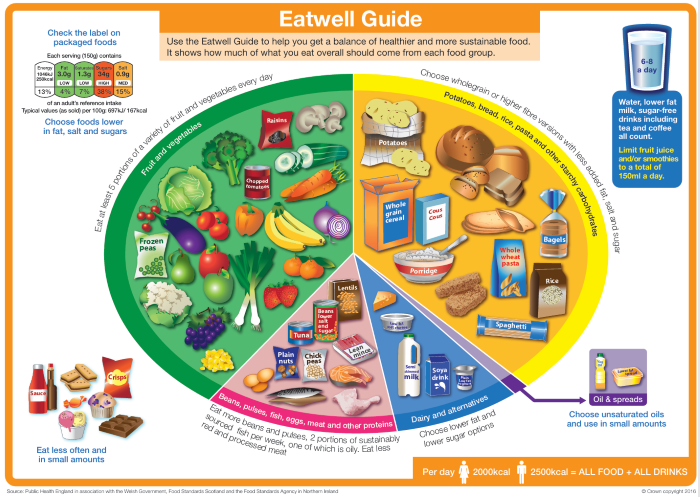
The Eatwell Guide provides a visual representation of the types and proportions of foods needed for a healthy balanced diet to promote long-term health at a population level.
The recommendations include advice to consume at least five portions of fruit and vegetables per day, wholegrain, higher fibre carbohydrates and lower fat, sugar and dairy options. The Eatwell Guide also recommends consumption of no more than 70g of red and processed meat a day, and replacing meat with lower fat, higher fibre proteins such as beans, pulses, fish and eggs.
Other recommendations include choosing unsaturated oils and spreads, limiting consumption of foods high in fat, salt and sugar, and drinking six to eight glasses of fluid every day.