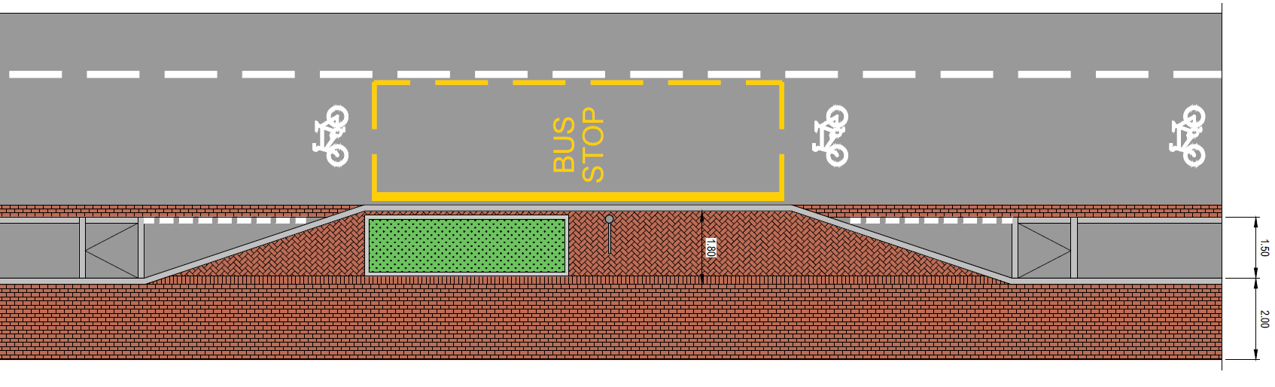
3.9.2 Cycle lanes at bus stops
Most new streets with a bus route will be Principal Streets (Type 1). The volume of traffic on these streets means many of these will require segregated cycle lanes.
Where there are segregated cycle lanes and bus stops, one of the following arrangements must be used.
- Bus stop bypass
- Bus boarder with discontinuous cycle lane
Shared-Use Bus Boarder designs, where passengers board or alight directly into a cycle track, must not be used in new schemes. DfT statutory guidance places a pause on these designs due to:
- Safety and accessibility risks, particularly for blind and partially sighted people:
- High conflict risk between cyclists and passengers: and
- Poor user confidence and negative perceoption of safety.
This is not a blanket ban on floating bus stops, and appropriate designs outside where boarding/alighting does not occur straight into a shared pedestrian/cyclist space remain acceptable.
Continuous cycle lanes in front of bus stop boarders, and bus stop islands must not be used. Passengers must be able to board a bus from the waiting area without crossing the cycle lane.
On primary routes, bus stop bypasses are the preferred solution and must be used where there is space.
Boarders, with discontinuous cycle lanes, should only be used on secondary streets, or lower, and where there are up to 2 buses per hour. As outlined above, please refer to updated DfT guidance on bus boarders or bypassessopens new window
Design rules for the two kinds of bus stop are set out below.
Bus stop bypass
The cycle track is taken behind the bus stop, allowing enough space at the kerbside for a shelter and waiting area. A pedestrian priority crossing will provide access across the cycle track
Where bus stop bypasses are provided, the design shall include a dedicated passenger waiting island between the carriageway and cycle track, with pedestrian access across the cycle track via a zebra crossing. The layout shall provide a minimum island width of 2.5m (3.5m preferred), a minimum footway width of 1.5m (2.0m preferred), and a minimum cycle track width of 1.5m (2.0m preferred).
The design shall incorporate tactile paving, clear visual and tonal contrast between pedestrian and cycle space, and features to reduce cyclist speeds on the approach to pedestrian crossings. Bus stop bypasses should be used in locations with medium levels of pedestrian and cycle activity and are generally suitable within urban and suburban environments.
The cycle lane alongside the bus stop must be reduced in width to encourage slower cycling. One-way: 1.5m Bi-directional: 2.0m
The cycle track must be set lower than the pavement, with the crossing must be at pavement level, to encourage cyclists to slow down and change priorities.
A rumble strip, and changes in horizontal alignment, could also be used on the approach to the bus stop to encourage cyclists to slow down.
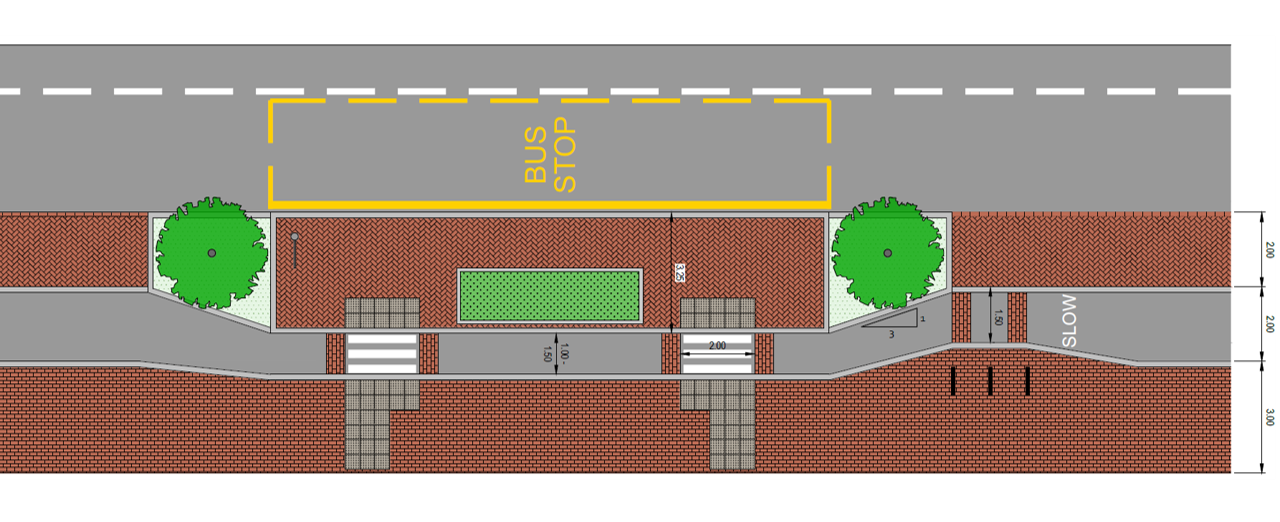
Boarder with discontinuous lane
The cycle lane is paused at the bus stop, requiring cyclists to give way and use the carriageway for a short section alongside the bus stop
A bus stop boarder with a discontinuous cycle lane shall only be used where cyclist and pedestrian conflict risk is demonstrably low. This arrangement is appropriate only in locations with low cycle flows, low traffic speeds, and low general traffic volumes.
Cyclists shall remain within the carriageway, either in mixed traffic or within a marked cycle lane where appropriate. The use of this arrangement shall be supported by evidence demonstrating that it can operate safely and comfortably for all users, with minimal potential for conflict between cyclists and bus passengers.
This arrangement must include an advisory cycle lane before and after the bus stop cage.
In addition, the following road markings must be used:
- A cycle symbol (diagram 1057) before the start and end of the cycle lane 10 and 20m before the 'exit' from the cycle lane.
- A give way triangle at the 'exit' from the cycle lane (diagram 1023).