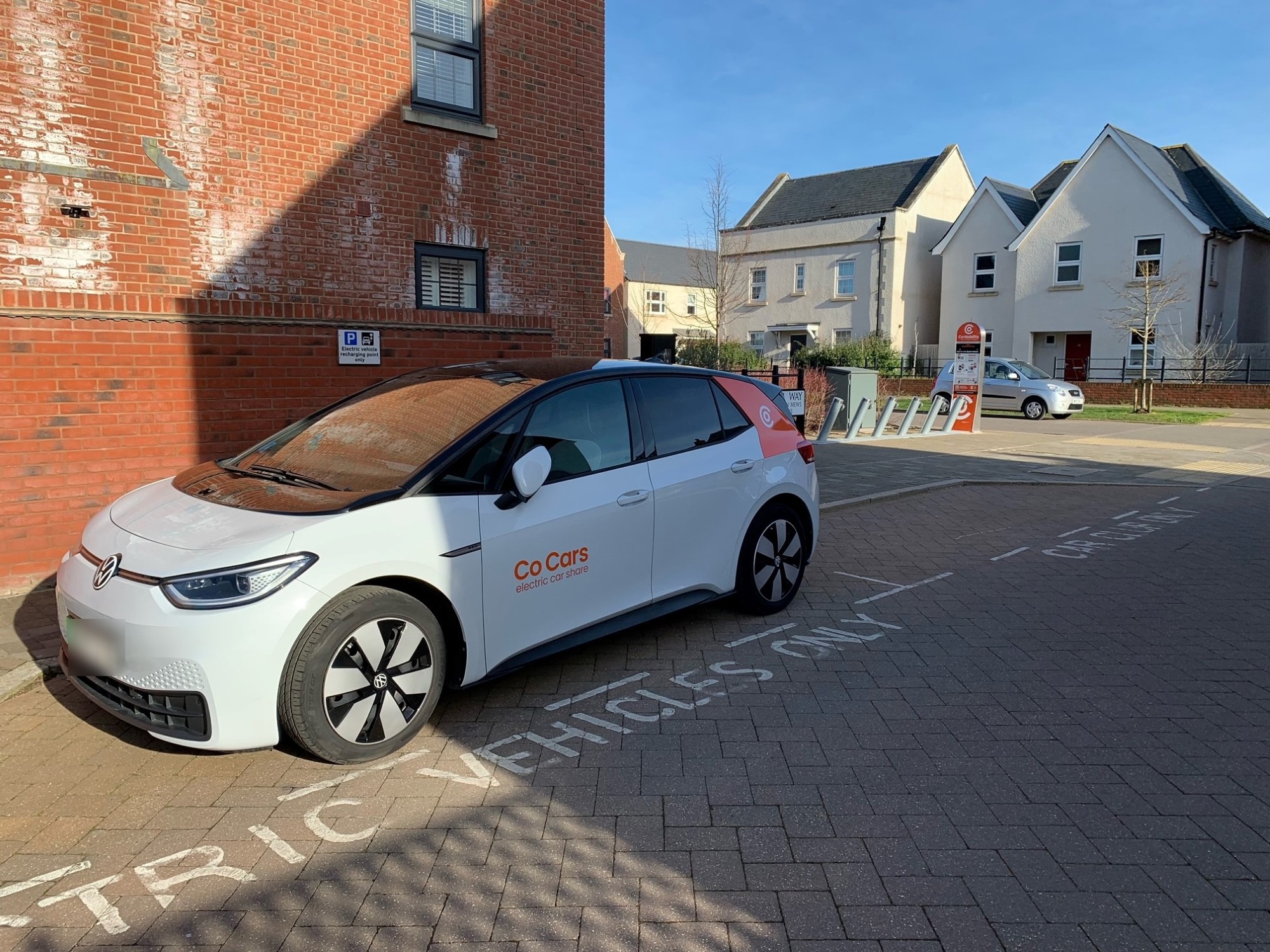
3.8.6 Car clubs
Car clubs can offer affordable alternative to a new or second car and significantly reduce the amount of parking space required in new developments. One car club space can replace the need for twenty private cars (Credit - CoMo UK Car Club Annual Report UK 2021).
Car club parking spaces shall be provided in prominent, highly visible locations with convenient pedestrian access. Spaces shall be clearly identified through signage and surface markings, include EV charging infrastructure where appropriate, and be designed as an integrated part of the street scene.
The following rules apply to the provision of space for car clubs.
All medium and large housing developments (more than 50 homes) should provide spaces for car clubs. These spaces must be clearly marked and located throughout the development, particularly in areas of higher density and in local centres, and must include EV charging facilities where possible. As a minimum, a passive provision for EV charging should be made.
As a minimum, the following number of spaces should be provided.
- 1 space for developments of between 50 and 99 homes.
- 2 spaces for developments of between 100 and 149 homes
- 3 spaces for developments of between 150 and 224 homes
- 4 spaces for developments of between 225 and 299 homes
- 5 spaces for developments of between 300 and 399 homes
- 1 space per 100 homes (rounded down), plus 2 additional spaces, thereafter.
For example for 530 homes: 5 spaces + 2 = 7 spaces.